
He drew from Wenger and Simone Inzaghi.
A year and a half ago, Como was promoted to Serie A. Cesc was already making headlines; his transformation into a coach was destined to attract attention, but during his year in the lower division, he demonstrated something more. Fabregas played differently from other Spaniards. Not the way he was expected to.
In his first match, he lost to Motta 0:3, and by mid-December, he was in the relegation zone. Respected veterans advised him to play more cautiously. Cesc retorted: «If I’m destined to be relegated to Serie B, it will be because of my ideas.»
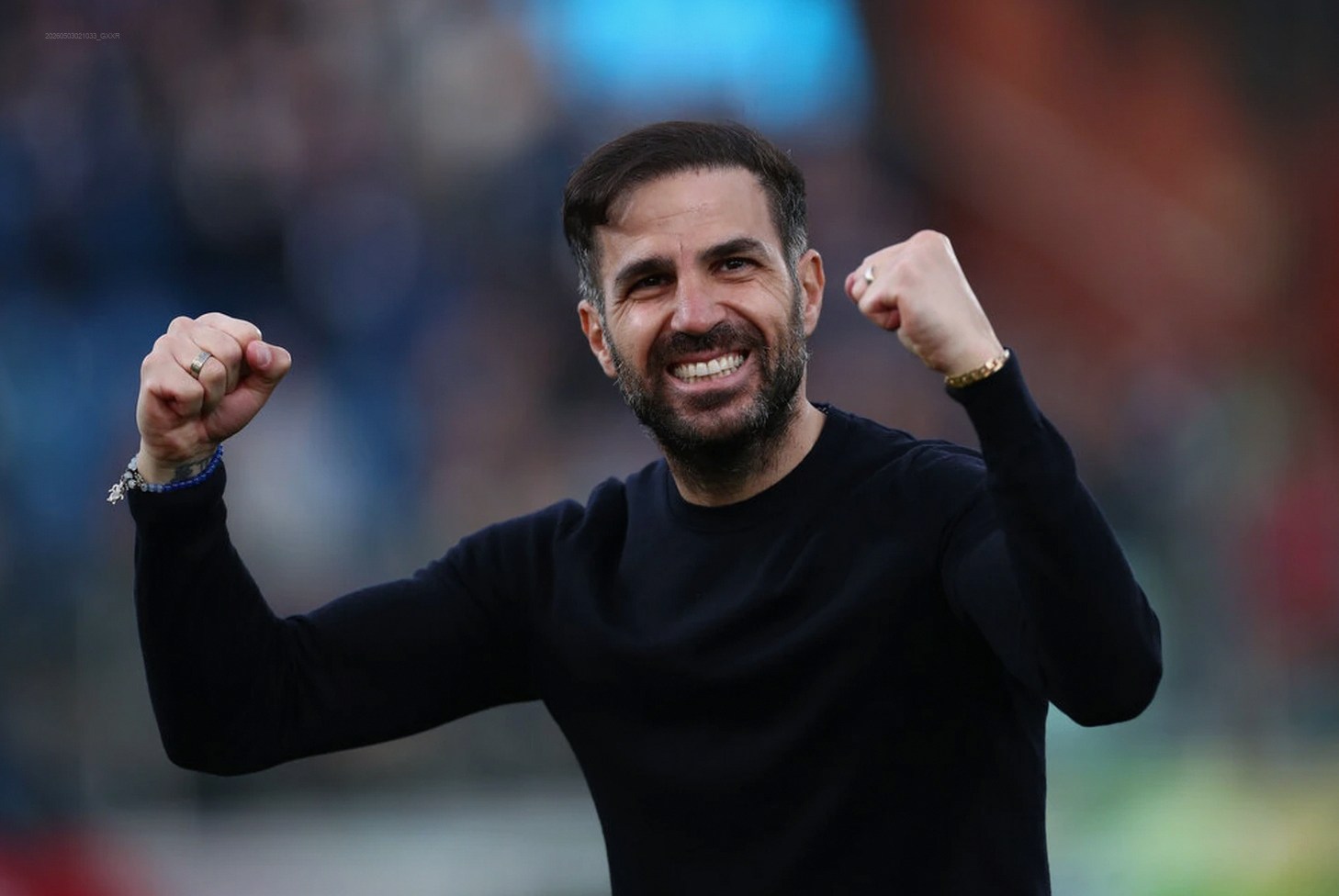
But Como has recovered. And now they are fighting with Juve for a place in the Champions League.
Cesc is primarily a student of Wenger. But not only his
Three or four years ago, Cesc talked about football like a typical Pep novice. He wanted to press and control the ball. He spoke about the game as if he had placed the field in a glass ball: numbers, structures, static situations. He was quite ordinary.
What was truly interesting in his vision went beyond the Catalan experience. Fabregas was oriented towards Wenger. Essentially, he dreamed of positional certainty combined with Arsenal’s verticality.
If he had started in another country, we would probably be discussing a much less unique coach. The Italian reality sobered Cesc up. As he was finishing his playing career, he already saw himself as the main man and did an interesting mental exercise after matches: he imagined how he would manage the scenario – for both sides. Perhaps he had no problems when he played against himself. But in finding the keys to the opponent, Cesc realized: it would be hard to win based on Catalan templates.
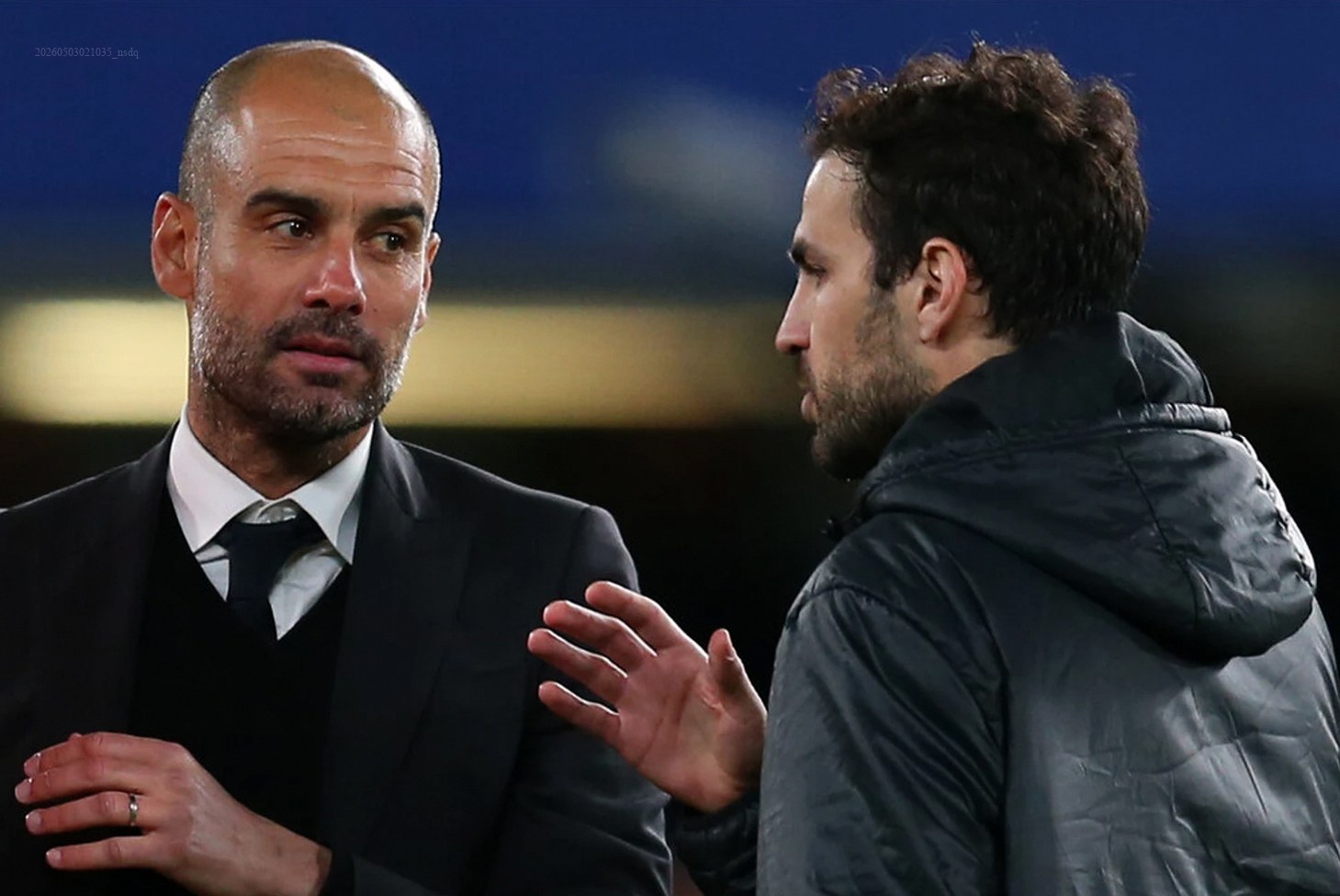
«I remember what I was like a year and a half ago, how I talked about football then and how I play now. I’ve grown remarkably,» Fabregas admitted. «I’ve come to understand what Serie A is all about. It’s a unique world and a unique level.»
The world would have been much duller if Cesc had responded to the challenge the way some other positional coaches do—by refining standards. Instead, he reevaluated his approach. The Spanish doctrine became an ornament; the foundation was built on lessons from others. Fabregas has fully embraced Wenger’s philosophy. While Pep insists that positions are key, Cesc spreads heretical teachings.
He had previously cautiously shown defiance: «We were wrong to think that positional play means a player should always be where they’re told. Football is a complex sport. The game offers many different aspects, many situations… And you constantly tell players which zones to occupy, how to play, where to move. Football isn’t like that. We’ve made players too robotic.»
Now, he transparently hints that modern positional football doesn’t work and cites Spalletti as an example: «There’s so much movement, so much dynamism in football, and here in Italy, they play 1-on-1 all over the field—more than in the rest of Europe. If we’re static, man-markers will always be behind us. It’ll be impossible to play, understand? The solution is mobility. Look at how ‘Juve’ has grown, how classy they are. We analyzed their matches. They play vertically with a player under the main group. He stays lower to create an overload, while the others run behind, attack space, and free themselves for 1-on-1 play… ‘Juve’ has done an amazing job.»
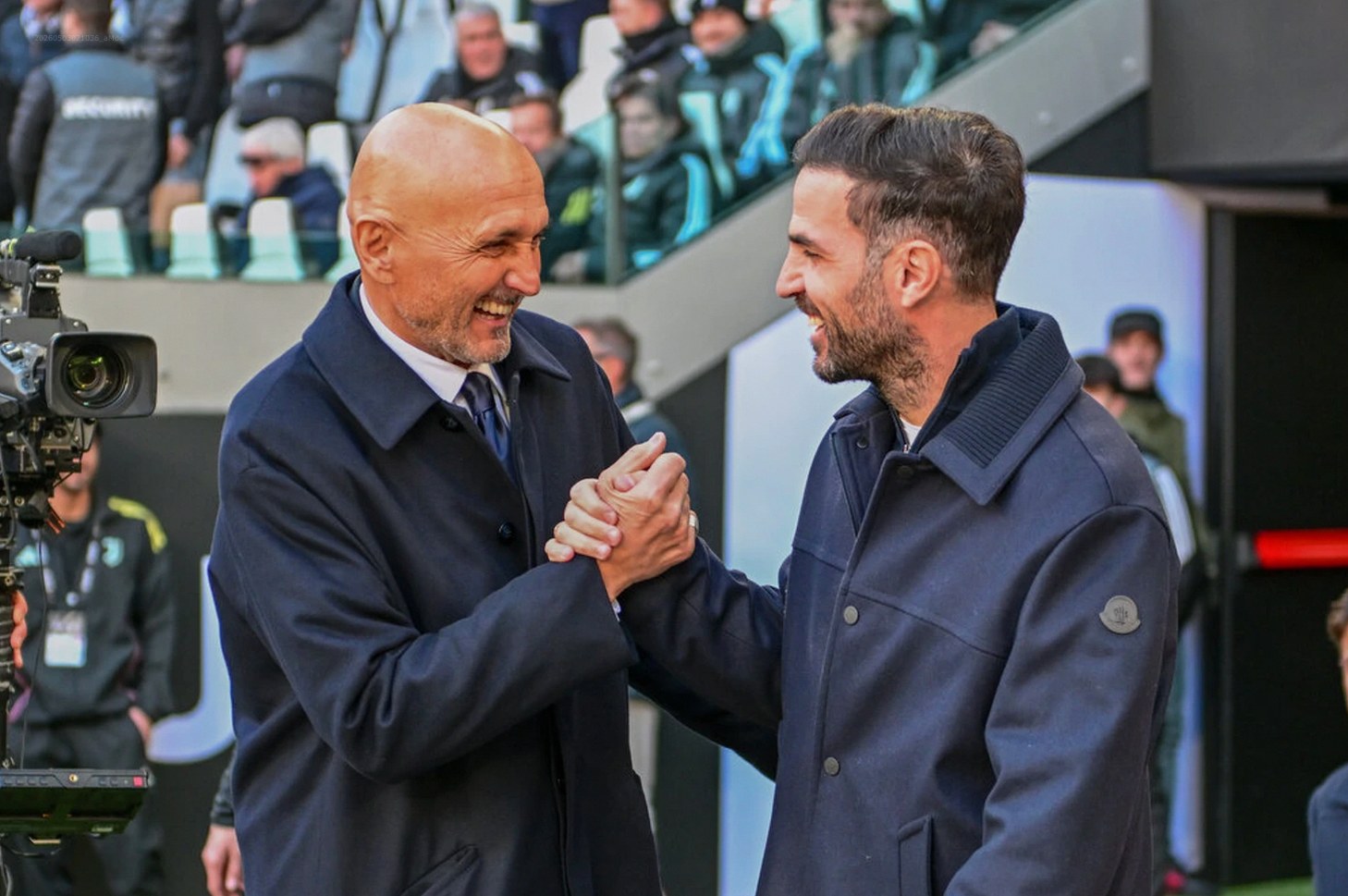
To embark on this journey, Fabregas spent several years studying leading Italian coaches. He supported Motta when he was on the verge of a split with Juventus. He met with Italiano. He absorbed a lot from Sarri. But he particularly diligently tracked Simone Inzaghi. In 2023, when Cesc was just starting his career and hadn’t yet shed certain preconceptions, Inter’s play opened up a new world for him: «A dominant 3-5-2 with clear movements… it all seems incredible. I see complete chaos, but behind it lies a tremendous amount of work.»
A year later, Fabregas faced Inter in Serie A and after the match, he asked the Milan bus to wait so he could speak with Inzaghi. And on an away trip, he even knocked on his door himself: «I went into his office, and we stayed there for 15-20 minutes. We talked about training, personal matters… I tried to understand how he implemented certain things at Inter that I really like.»
But there was more. Cesc didn’t only learn from positive examples. Negative ones guided him as well.
Conte showed how not to do it. Perhaps he wasn’t the only one
One of Cesc’s arguments against positional play went like this: «Modern footballers learn tactics from a young age. The coach assigns you as a full-back, midfielder, winger, and devises set pieces. As soon as a player gets used to it and adapts, they’re told exactly what to do. There’s no room for creativity, imagination, for finding space and the moment. But the game depends on movement. If the left winger Batshuayi moves into the center, space opens up on the wing, and someone else needs to attack it. If Batshuayi drops deeper, space appears higher up. All of this needs to be trained and explained. No, I don’t tell the guys what to do. I teach them to do one thing because others are doing something else: ‘If my teammate goes here, I’ll go there and give everyone an idea.’ Then we review and discuss, the guys explain their decisions, and for me, this is fundamentally important: this is how I understand how my players think. Football cannot be robotized. I’ve been a robot once or twice when I played myself. I don’t believe in that path.»
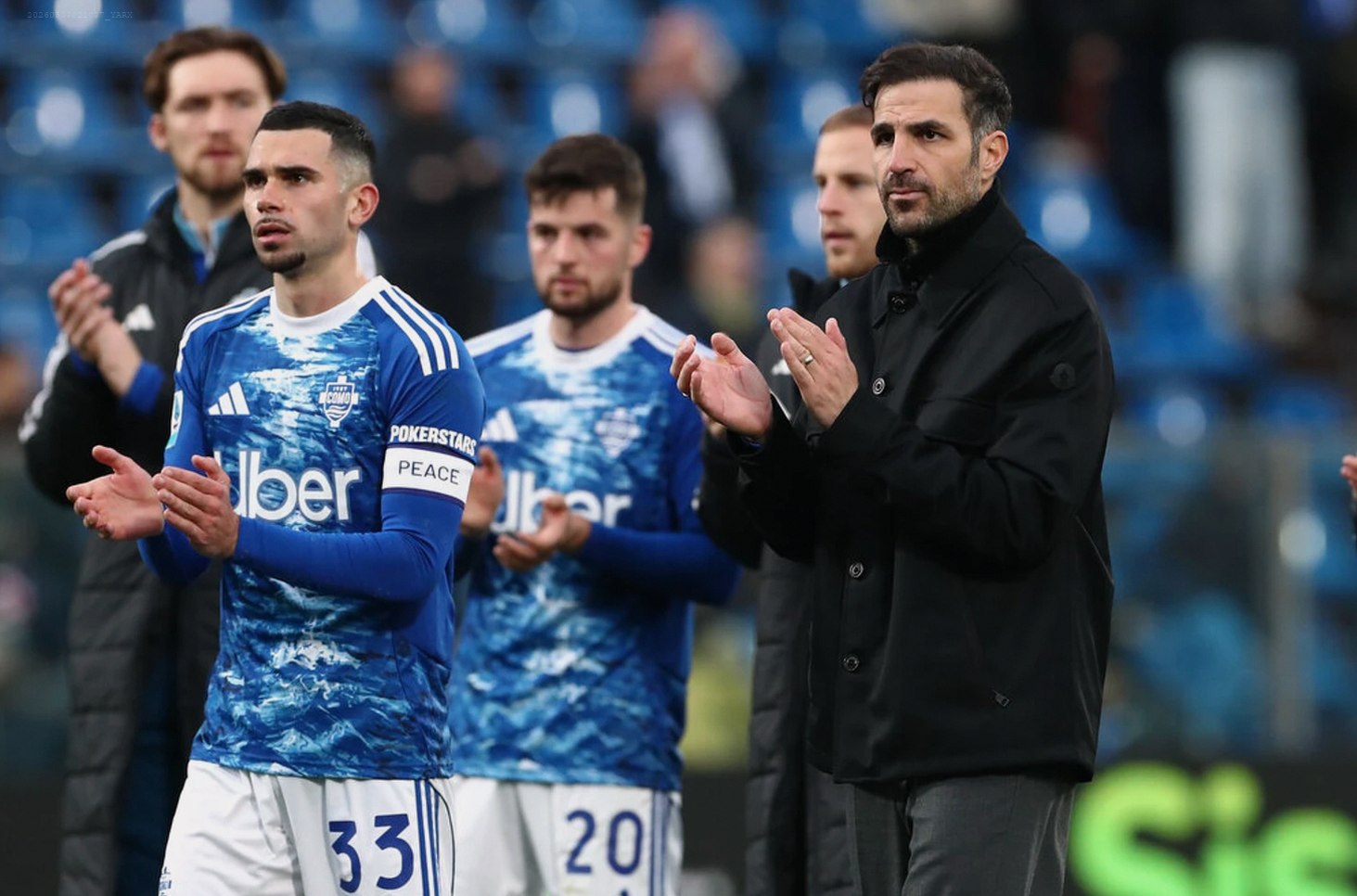
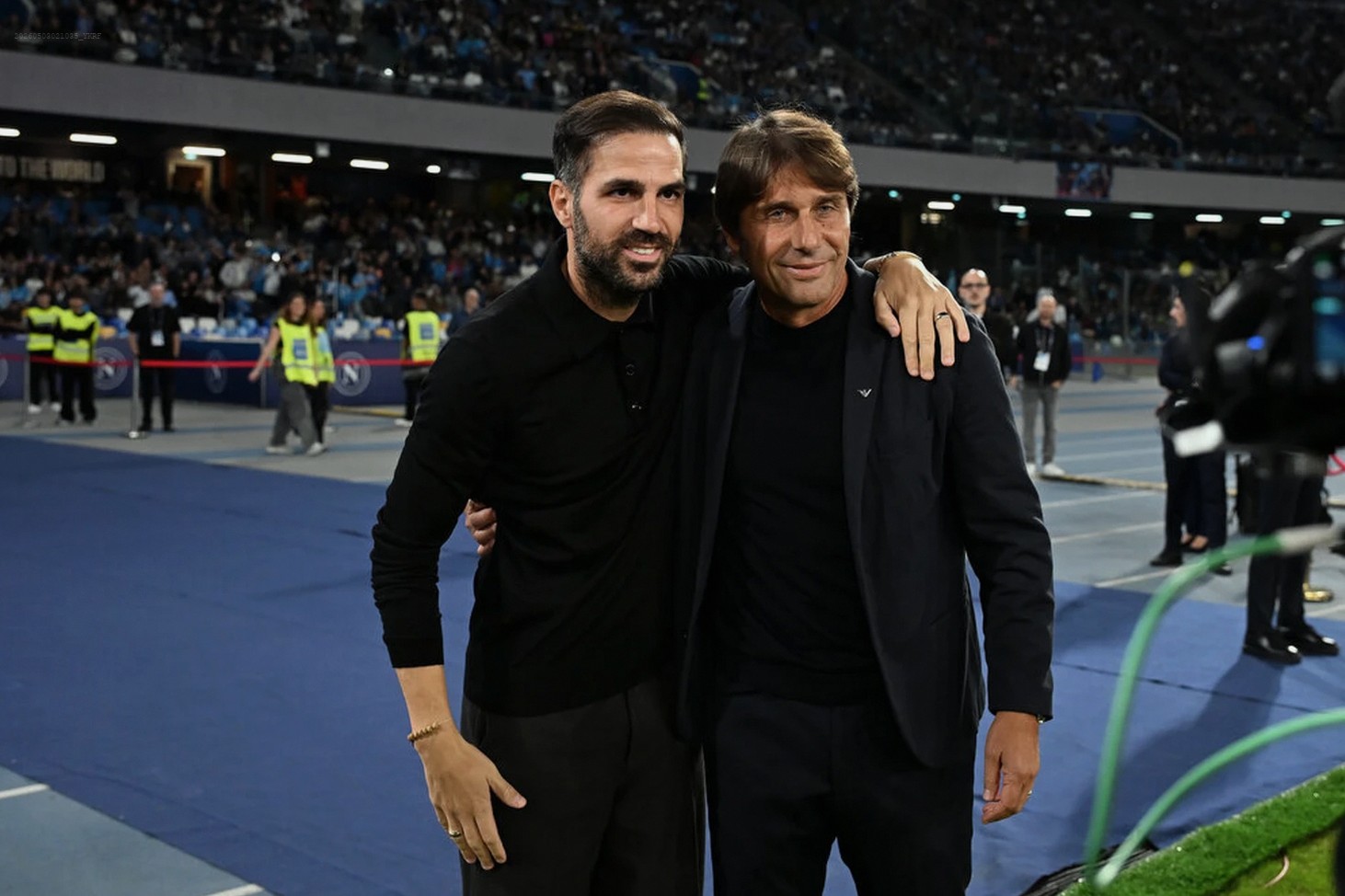
The words spoken at the end and emphasized by us are primarily about Antonio Conte – the most controversial experience in his career. Perhaps Cesc himself hasn’t fully decided what he thinks about it. But the truth is that Conte’s influence on Fabregas as a coach is quite clear. The ideas that «Como» stands on largely stem from the desire to create something opposite. The Italian taught him how not to do things.
“Conte worked more tactically and physically with players than any other coach. He always clearly communicated what we had to do. For a while, it worked. But we always did everything, and it didn’t inspire me,” Cesc explained. – My strength lies in intuition, the ability to find free space at the right time. Every episode in the game is dictated by how the opponent is positioned. You can’t order a player to always do the same thing. Therefore, my vision of football is to help the guys look good in every episode. It’s not easy. It takes time, dedication, many individual and team sessions. But I believe it’s the best way to feel strong in the game.”
However, Conte is not the only antagonist. Cesc speaks of two: “I’ve been a robot once or twice.” The second is likely Pep. At least, he’s the prime suspect. If you were to rank the most scripted tactics Cesc has encountered, the Catalan would be second. Indirectly, he himself confirmed this. Long ago, still a player, trying to emphasize the degree of automation under Conte, Fabregas noted that Antonio is mechanical even compared to Guardiola.
There’s something of Pep in Cesc, but also something of not wanting to be him. And a lot of not wanting to be Conte.
How does «Como» play?
Fabregas’s football is exactly what he says: adaptation to each episode through abandoning positions and trusting intuition.
«Como» starts possession with a positional structure. Which one depends on the opponent and the moment. There are easily enough variations for a separate analysis, even if we focus on the most striking ones. And yet, the most interesting part begins when they deviate from the prepared patterns.
Remember, we said that Cesc used to think about the game as if he had placed the field in a glass sphere? The little world inside the snow globe comes alive when it’s shaken. It’s the same with «Como.» They start with prepared frameworks to see what challenge the game will present – and then the magic happens: statics turn into dynamics, elements interact according to unpredictable laws; the content comes alive and transforms.
For example. «Como» typically spreads out across zones: width, half-flank, central, and deep channels.
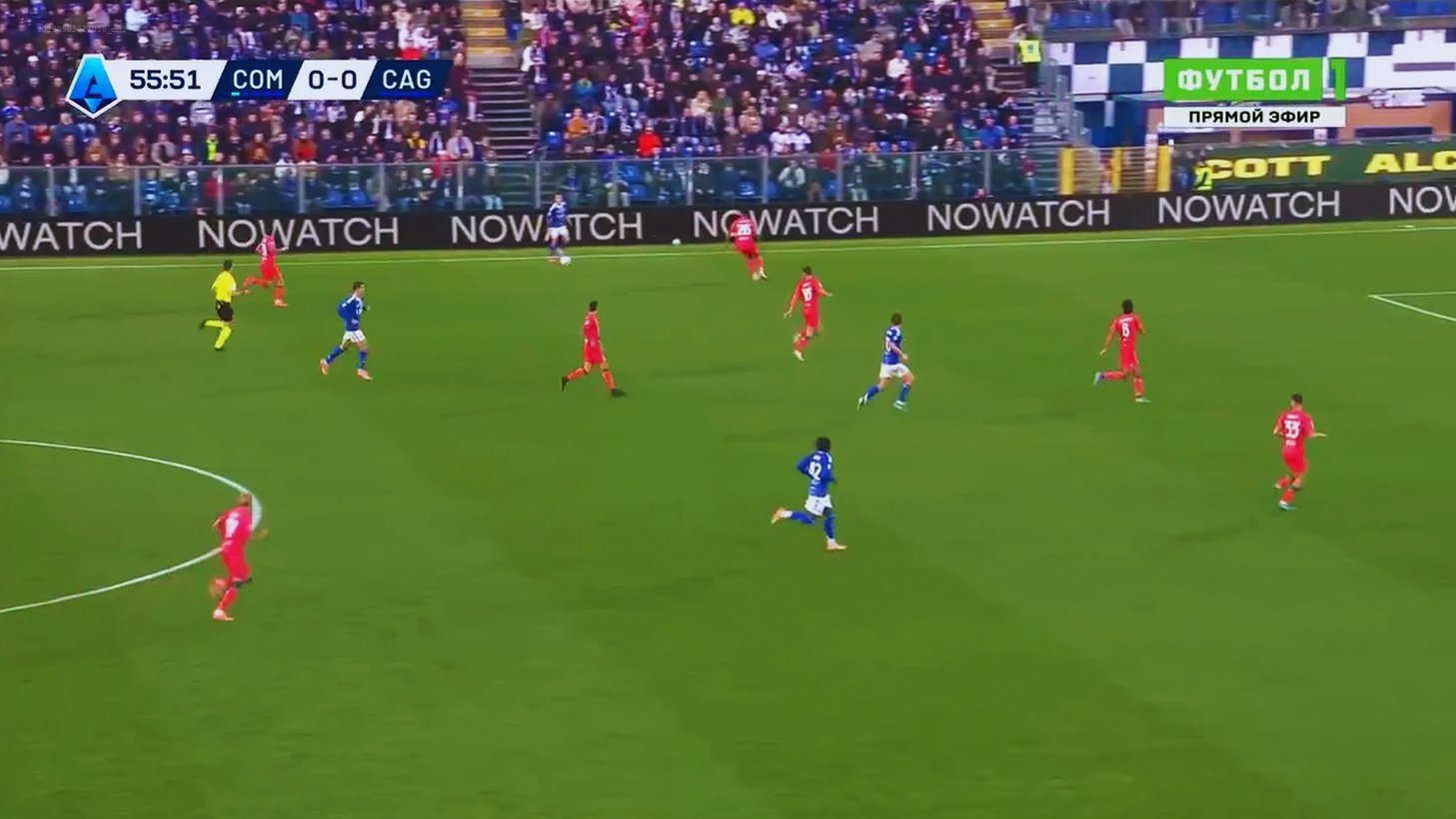
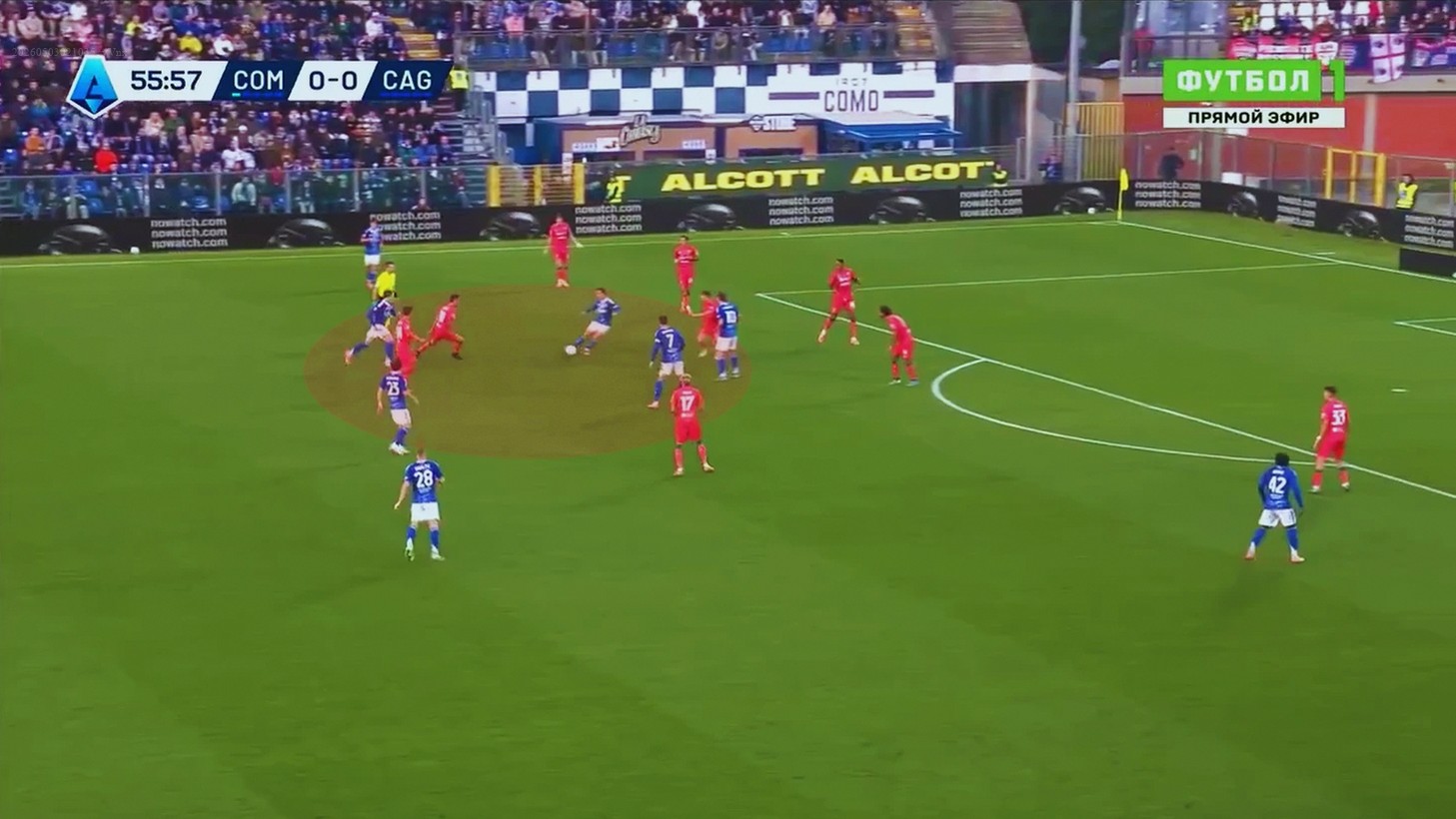
But the players are not placed in mandatory zones, they leave them. They move towards the ball and towards each other to occupy a tight five-man area.
Here is another example. In positional attack, «Como» is not arranged in the standard 3-2-5, like any team in the Era of Guardiolism. Seven outfield players shift to the left side. They form a vertical structure diagonally to each other.
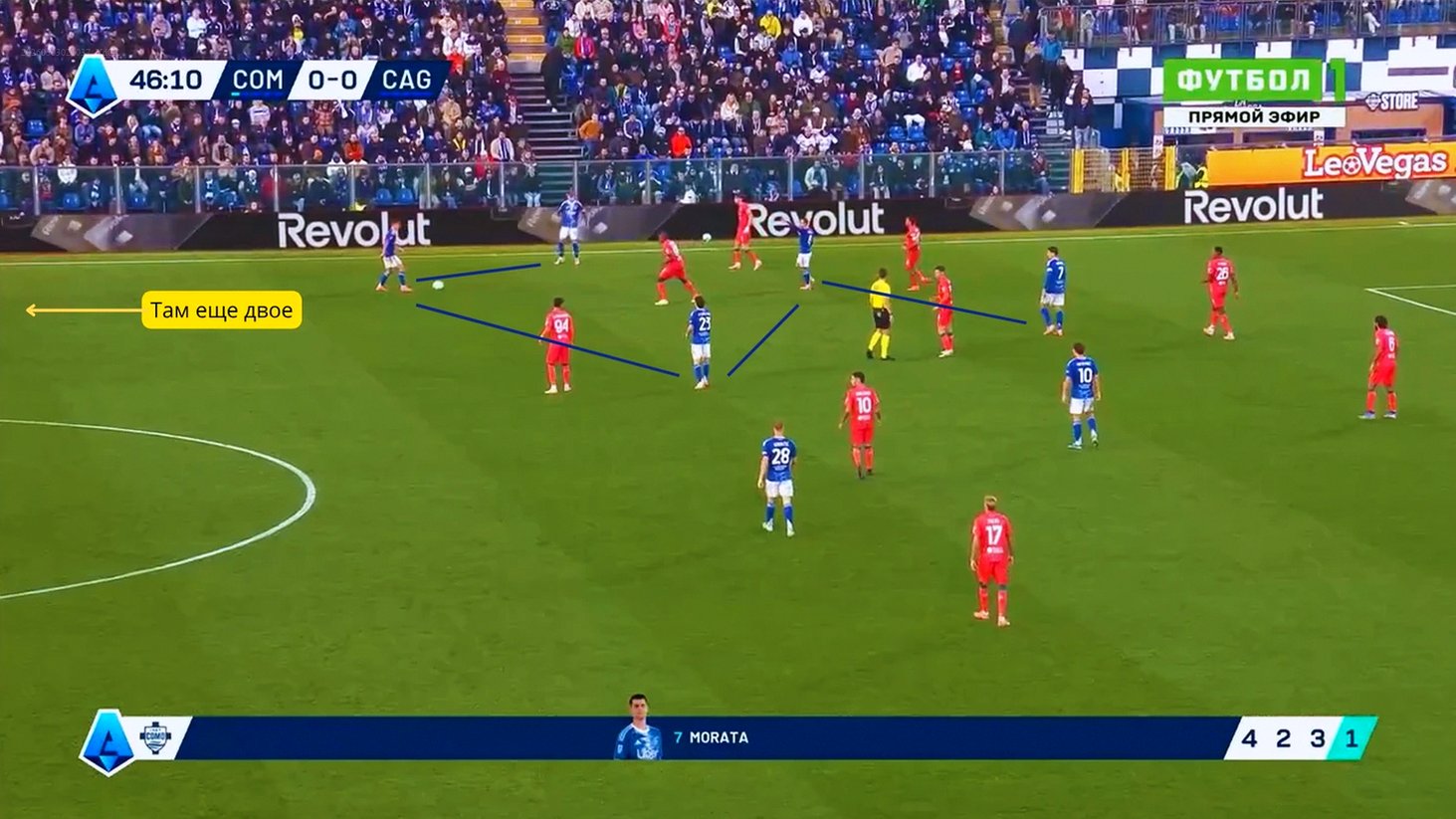
When the ball moves to the center, they shift and eight players occupy one part of the field. There are no fixed positions. There is only a clear intention to provide the passer with as many options as possible for a vertical pass. At the same time, each player is positioned to pass the ball further in one or two touches.
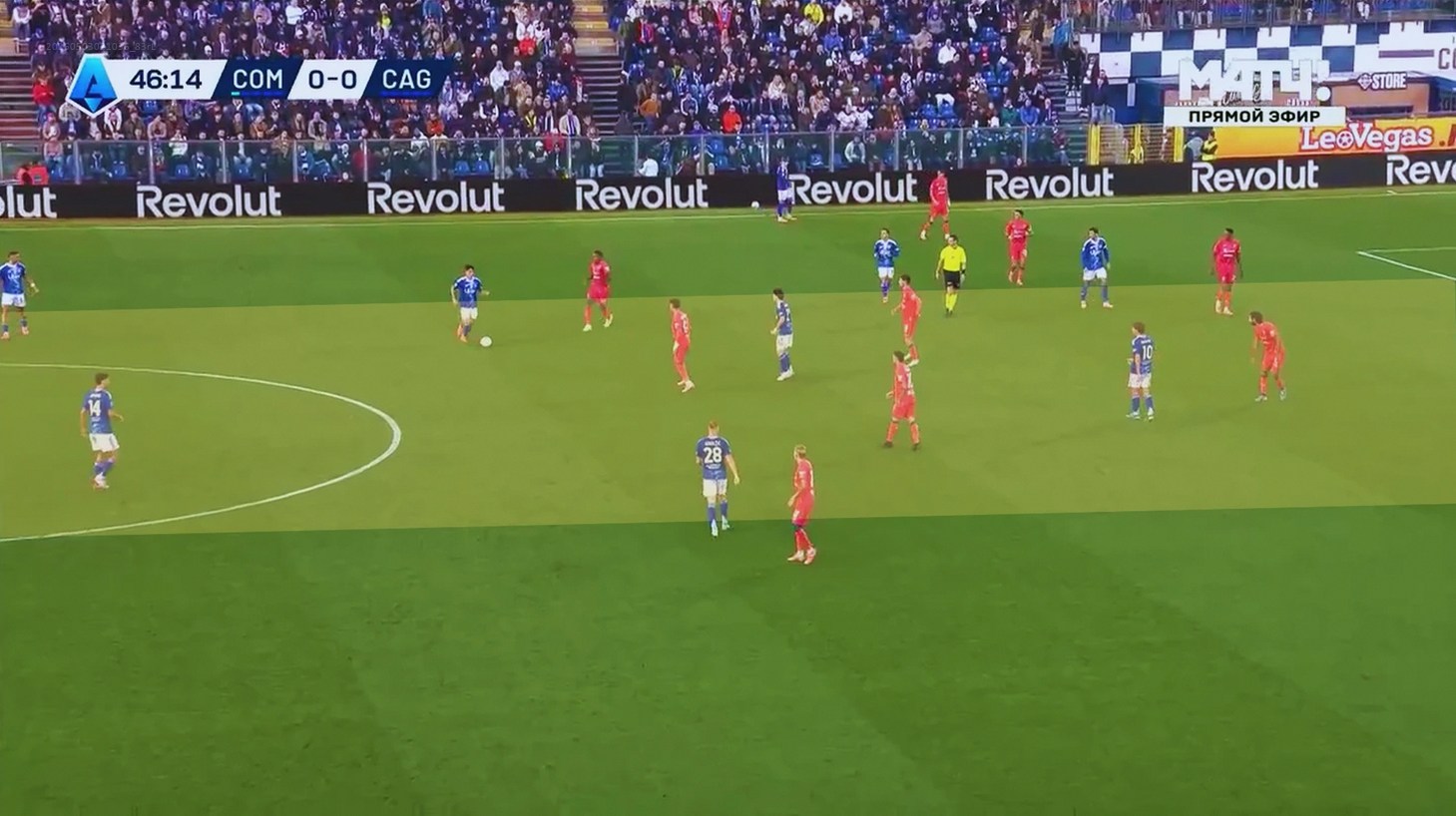
Cesc explained where this came from: “Wenger studied the best players in the world and noticed: before receiving the ball, they scanned the field 15-20 times. If you want to become a top midfielder – you must do this.
He insisted that a midfielder should play forward, and instilled in me that the correct posture before receiving the ball is the key to victory. If you look back and close yourself off, poorly positioning your body, you will never pass forward. Not with one touch, not with two.
My obsession with playing forward comes from Arsène. He believed it was the main quality for a midfielder. When coaching kids, I repeated the same thing to them: ‘Since we need to attack the opponent’s goal, that’s where we need to look.’ How? That’s the coach’s job. I teach players to position their body and scan the field.”
Diagonal connections are also important: each such pass forces the defensive block to turn and lose nearby players from their field of vision.
Thanks to this, Como, having the most ball possession in Italy, remains a vertical team. Among the league’s top ten in cutting passes are three of Cesc’s midfielders: Pas, Perrone, and Cocre. The club has scored 7 goals in quick attacks – only Torino and Juve have more.
I’ll show how it all works together.
Here’s a typical positional attack. Como occupies zones and shakes up the game with a vertical pass.
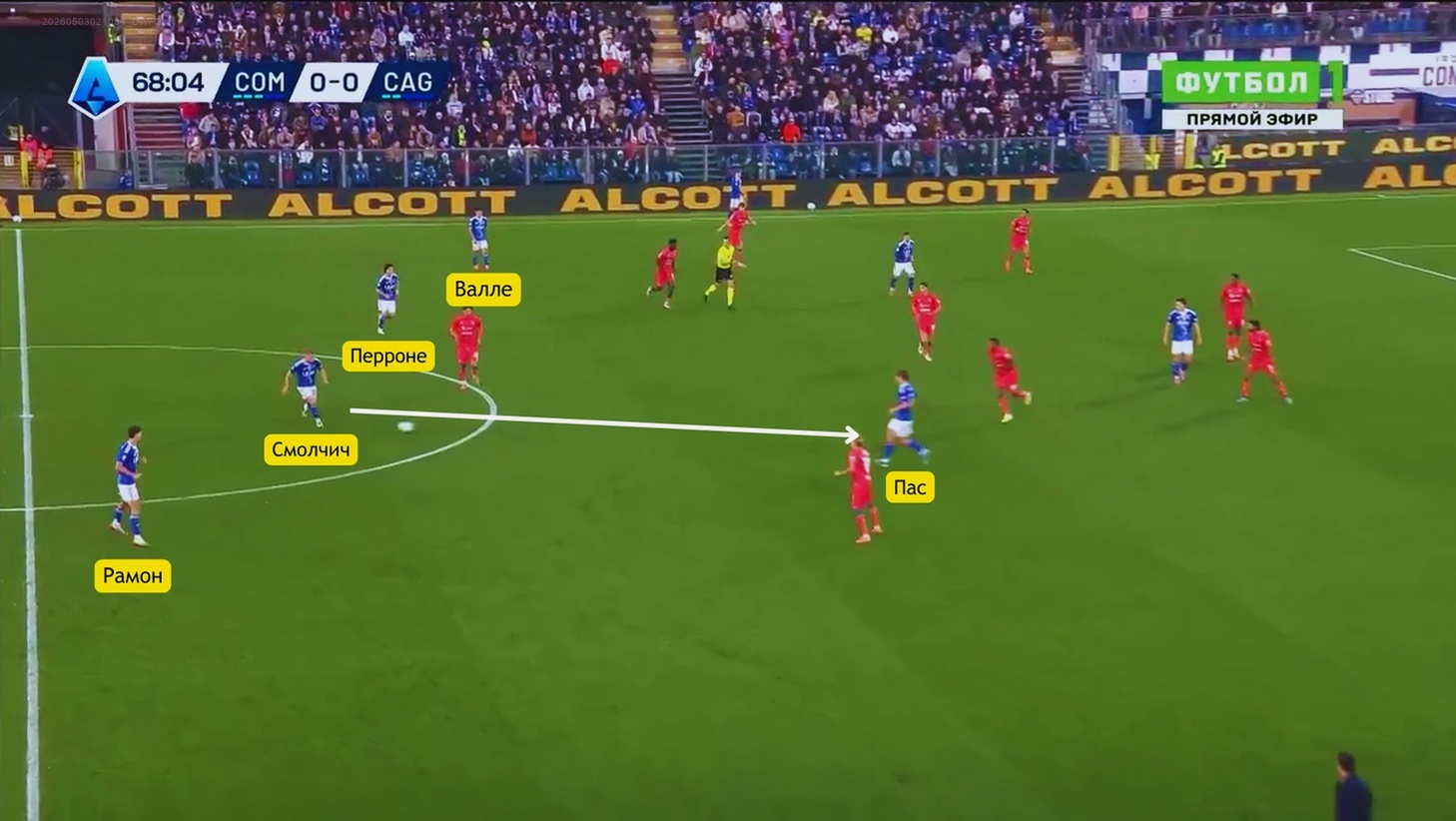
Watch what happens next. The players don’t maintain distance to comfortably pass the ball. They orient themselves towards the ball and teammates, not zones. Six players are drawn together, creating a mini-field within the larger one. Ramon and the wingers are excluded from the action. They are the safety net, a ghostly structure in the free-flowing game. If something goes wrong, the ball can safely be played back to them to restart possession.
But the action itself takes place in the improvised mini-field. Notice what Smolcic does after the pass. He moves. This is the first rule, pass-and-move: you can’t stand still after passing the ball. Inside the mini-field, there are no positions; they remain with those on the outside. Inside, there are only functions. No tasks dictated by the coach or formal roles. There are only those dictated by the game’s dynamics.
Nico Paz played a diagonal pass to Perrone. The opponent turned towards him, and in this mini-field, a blind spot appeared. Smolcic starts moving into the corridor to exploit it.
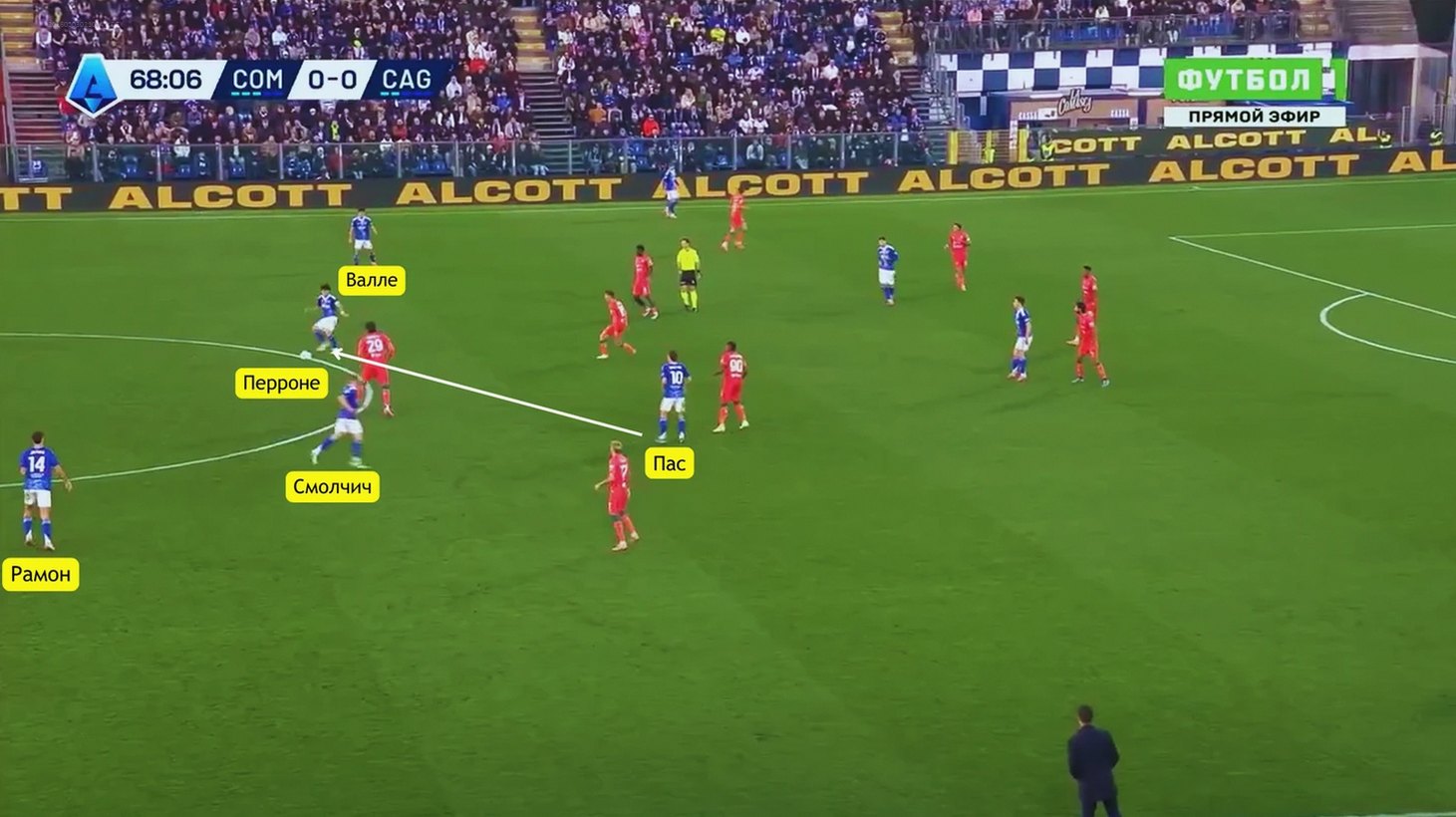
But Perrone, turning around, passed to Duvikas. The opponent turned in the previous direction. Smolchich is visible. He stops moving and again becomes the supporting passer in this mini-field. But on the other side, Valle falls out of sight – and he immediately accelerates through the blind corridor.
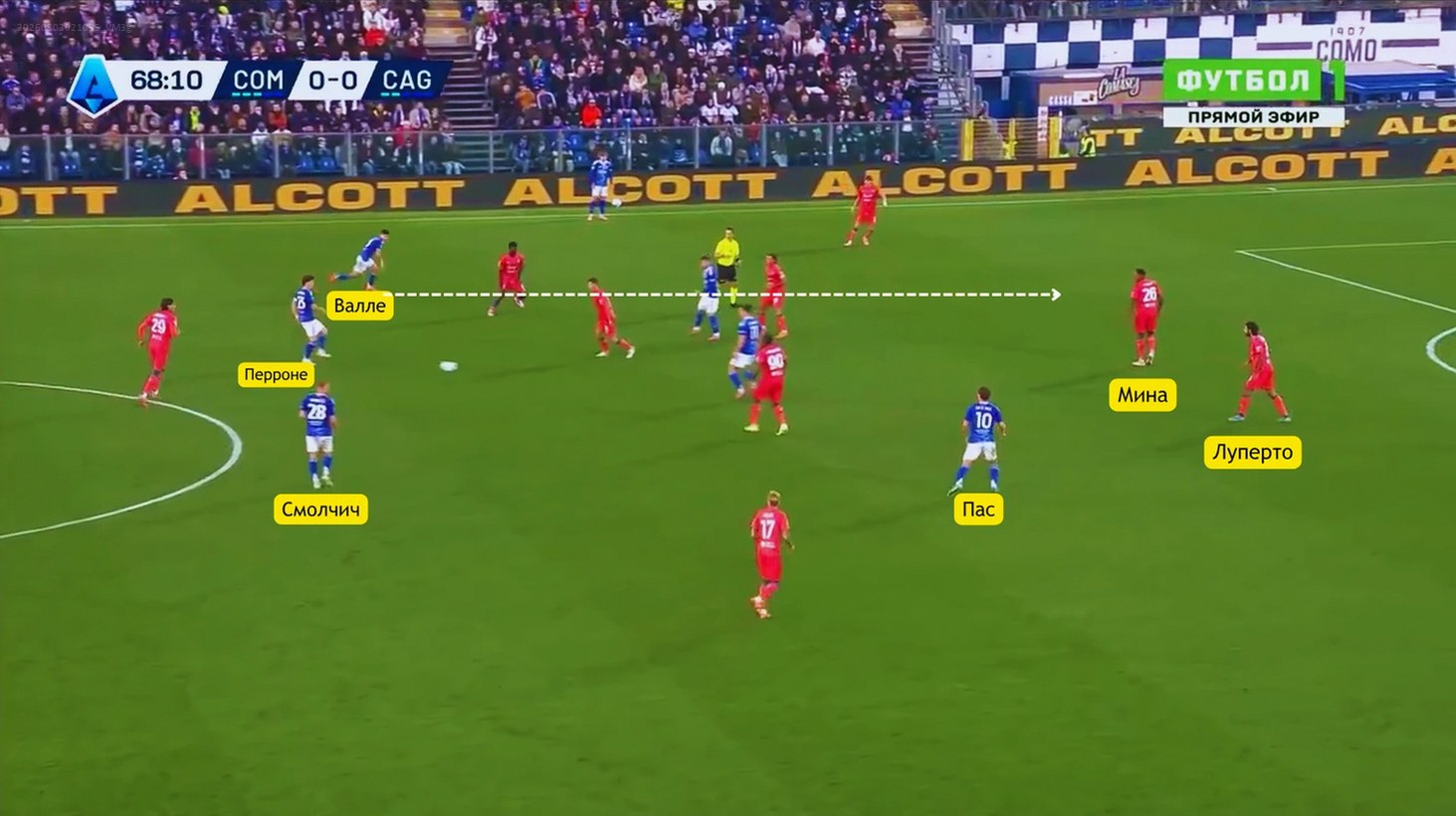
See what it led to? Como tore apart their opponent with just a few passes. Mina and Luperto, Cagliari’s center-backs, faced an unpleasant dilemma: follow the forwards and leave space behind, or stay and let Pastore roam freely between the lines? They chose the latter, but their problems didn’t end there. Valle runs into an empty corridor, unseen by the entire central group. Only the opponents who didn’t go into the tight box are marking him. If the full-back reacts, Como’s winger is left open on the flank. If the center-backs react, Pastore will run into an empty penalty area. If no one moves, Nico calmly receives the ball between the lines and, together with Valle, creates a two-on-two situation against the opponents.
This isn’t the football Fabregas grew up with. The Catalan positional school first occupies space and then looks for a solution. The opponent is manipulated by moving the ball through occupied zones. Como does the opposite: they first create space and then attack it. The defense is disorganized through movement. By abandoning positions and shifting towards the ball, Cesc turns an organized structure into chaos.
He didn’t say Italian football changed him for no reason. In Italy, man-to-man pressing dominates. It’s devastating against positional teams because they mechanically fill zones: you can target a player while maintaining defensive integrity. But Como operates illogically, at least from the perspective that has dominated European football for the past 15 years. They pass to a teammate even if an opponent is marking them; they run into zones already occupied by a teammate; they synchronously converge on the ball, violating Pep’s fundamental commandment. They break down the play into duels and win each specific one, ending the action before the opponent can intervene. Essentially, they change the object of manipulation: instead of moving the defensive block, they isolate and eliminate each opponent individually, one after another.
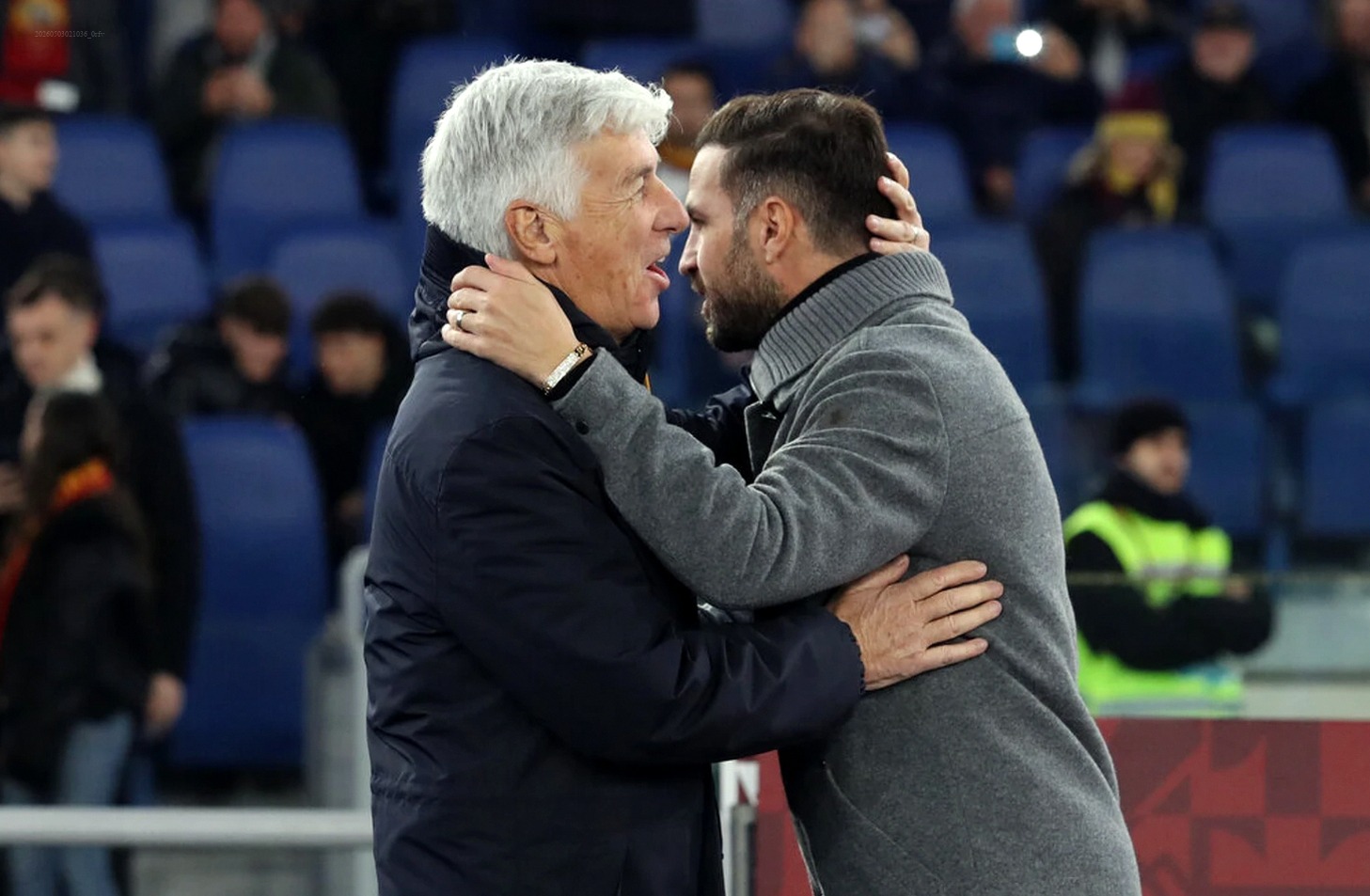
«Gasperini is special, he created an incredible methodology,» explained Cesc. «Spanish and English coaches often call and ask why I do this or that. ‘Because of Gasperini,’ I reply.»
In short, all that has been said can be described as follows. «Como» seeks not positional, but socio-affective advantage. «With individual tactics, you can only react. We know what we will do, and if we are on the same wavelength, you will always be a second behind.»
A special squad has been assembled for this style of football. Physically, «Como» is the weakest in Serie A. But they are one of the most technically skilled, especially in tight spaces. The wings are filled with explosive dribblers (Diao, Kyun, Jesus Rodriguez), the center with free artists (Pas, Batourina) and intelligent playmakers with vertical thinking (Perron, Da Cunha, Cocre).
Cesc deliberately puts them together: «When the players are on the same wavelength, the game belongs to them, not the coach. I don’t believe in robotization. Perron, Da Cunha, Cocre, Batourina, and Pas dominate thanks to creativity and a shared vision. They understand each other and the space. This gives a completely unique perception of football.»
What’s next?
«Como» has an owner with 44 billion dollars, a decent squad, and a well-built structure.
Nevertheless, «Como» is currently Cesc.
Cesc interferes in transfers and selects the squad to suit himself, even if the scouts are against it. Cesc organized a meeting with the coaching staff of «Bodo/Glimt» to borrow advanced nutrition management methods. Cesc demanded the installation of a giant screen near the training field, which broadcasts real-time drone footage: tactical errors are corrected on the spot, not in the locker room afterward.
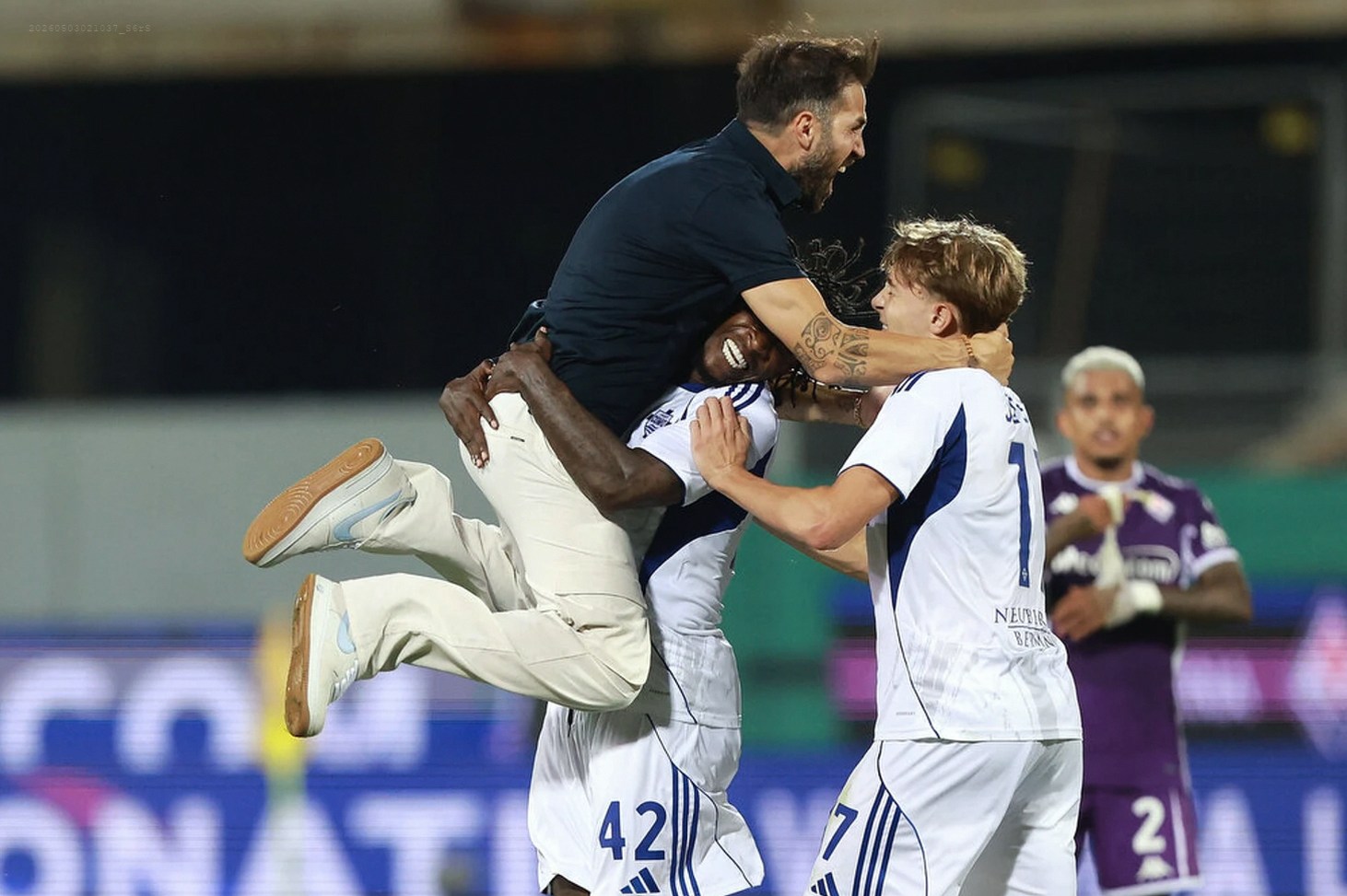
Cesc now is Como. Just as it once was with Gasperini and Atalanta, the future depends on how long he stays.
The Bergamasks once tied Gasperini by giving him a percentage of every sale. Fabregas has a different option. He owns shares in the club. But shares alone are not enough to keep him. No matter how fast Como grows, Cesc’s status grows faster. For now, he is interested in learning and building. Over time, he will want more.
The question is not whether it will happen. The question is when. And whether Como will be ready—either to let go without fear or to provide a new challenge.


If Arsenal messes everything up, then we need to do everything to bring Cesc back in the summer. Otherwise, I’d like to see him at Roma (no chance, of course) or at Barcelona after Flick.
Comment deleted by moderator
Carrick isn’t sleeping)
Fabregas was an intelligent midfielder when he played, and he played for top teams under top managers like Wenger, Mourinho, Del Bosque, and Guardiola. It’s no surprise that he’s becoming a good coach.
If only it always worked that way. Shevchenko worked with Ancelotti, Lobanovsky, and the same Mourinho, and didn’t learn anything.
And who said he was intelligent?
Cesc doesn’t need to go to Arsenal, he’s doing well at Como. No need to follow the path of new Premier League managers.
Actually, he should move to Arsenal. There’s a lot of money, he’ll get full trust, + they won’t fire him immediately after a few unsuccessful matches, but will give him full seasons to build. + If Arteta doesn’t succeed in terms of trophies, then the expectations won’t be as high. They now have a squad with which you can play almost any football. I think he can also move to Barca after Flick, where he’ll get a ready-made team, and won’t have to change the scheme or come up with something new, he can immediately implement his football without major adaptation problems for the players.
Cesc has the most trust in the top 5 leagues — club shares. Arsenal will never give that. Barca won’t either.
I thought Talalaev was the anti-Pep
Anti-Pepusha
The main question is — when did Luzhkov’s widow become a left winger?🤔
The attack is very well analyzed, but there’s a complete lack of defensive analysis. Here, Como players imagined a situation in the opponent’s third, pulling 8 players there and lost the ball. How do they adapt? How do they defend? Pressing? Positionally? How are roles distributed when the attacking structure is fluid? It’s interesting.
I’ll upvote to push your comment higher — let Andrey read it and provide a detailed analysis, I’m also interested.
Alonso to Liverpool, Lamps to Chelsea, Cesc to Arsenal, Carrick already in place, and we’ll bring back our 2007 (with some adjustments).
Then also Berbatov to Tottenham, so they don’t think about quickly returning from the Championship.
The Musketeers 20 years later)
Now Fabregas faces his first serious challenge in his coaching career — inevitable problems after a praising article on Sports.
Yesterday’s Spanish legends have turned into a wonderful group of coaches who will set the tone for the next decade. How comical the English veterans look against their background, who have all become miserable ‘experts’ on TV and turned out to be incapable of anything else.
Fabregas was lucky to immediately get into a comfortable environment where he can develop calmly and they’ll buy the necessary players for him. So he needs to think 100 times if he wants to leave this project now, when there are only two examples of Motta at Juve and Alonso at Real. In a top club, they’ll immediately demand the maximum, and he’ll have to adapt to the squad. Of course, there’s no equal to Conte with his automatisms, he immediately gave results everywhere.